

Kainte’s CNPDC/KNT-HMS Containment Hydrogen Concentration Monitoring System, Hydrogen Sensor, and Hydrogen-Sensitive Element Technologies Have Been Granted Invention Patents by the China National Intellectual Property Administration
Summary
The CNPDC/KNT-HMS Containment Hydrogen Concentration Monitoring System, jointly developed and submitted by Beijing KNT Technology Co., Ltd. and China Nuclear Power Engineering Co., Ltd., has been granted an invention patent certificate by the China National Intellectual Property Administration for its hydrogen sensor and hydrogen-sensitive element technologies.
The CNPDC/KNT-HMS Containment Hydrogen Concentration Monitoring System, jointly developed and submitted by Beijing KNT Technology Co., Ltd. and China Nuclear Power Engineering Co., Ltd., has been granted an invention patent certificate by the China National Intellectual Property Administration for its hydrogen sensor and hydrogen-sensitive element technologies.
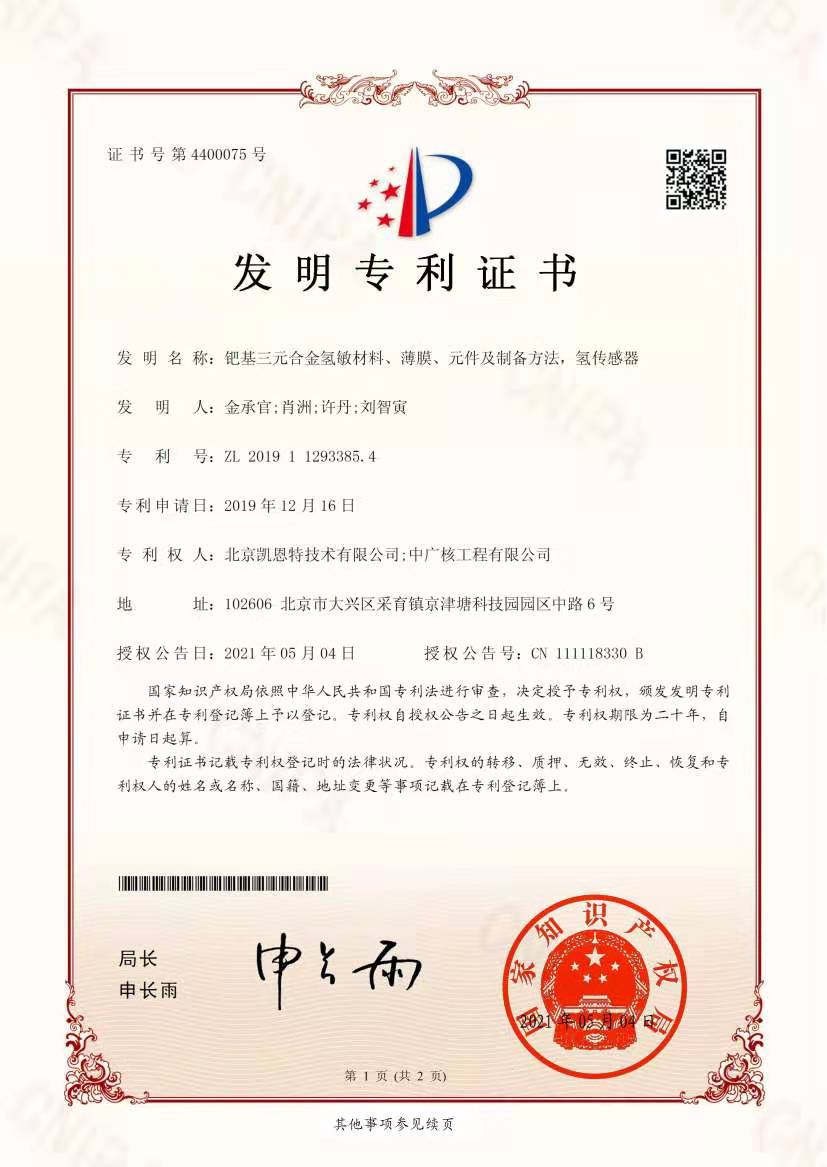
Patent No.: ZL 2019 1 1293385.4e466d1ab2c994ae402e73753f29e821e.jpg
System Configuration:
The containment hydrogen concentration monitoring system consists of hydrogen sensor probe modules, a processing cabinet, signal cables, and other components.
System Functional Design:
The probes continuously measure hydrogen concentrations within the range of 0–25 vol.% under severe accident conditions inside the containment, including temperatures of 0–180°C, pressures of 0–0.7 MPa, and relative humidity of 0–100% RH. The processing cabinet receives and further processes the probe signals. Its functions include power supply processing and redundancy, remote-control input and output, probe signal acquisition, processing and control, display, alarms, and 4–20 mA signal output.
Overview:
The invention relates to a palladium-based ternary alloy hydrogen-sensitive material comprising the following components by atomic percentage: Pd, 85%–95%; Y, 5%–12%; and Ru, 0.1%–5%. The invention also provides a palladium-based ternary alloy hydrogen-sensitive film, a composite hydrogen-sensitive element incorporating the film and its preparation method, and a palladium-based ternary alloy thin-film hydrogen sensor. Compared with hydrogen-sensitive films made from conventional binary alloy materials, the palladium-based ternary alloy film developed in this invention provides higher activation energy and hydrogen solubility, resulting in stronger hydrogen adsorption capacity, a greater number of hydrogen atoms accommodated per unit volume, and more complete dissociation following adsorption. As a result, hydrogen-sensitive elements and hydrogen sensors incorporating this film offer improved overall performance.